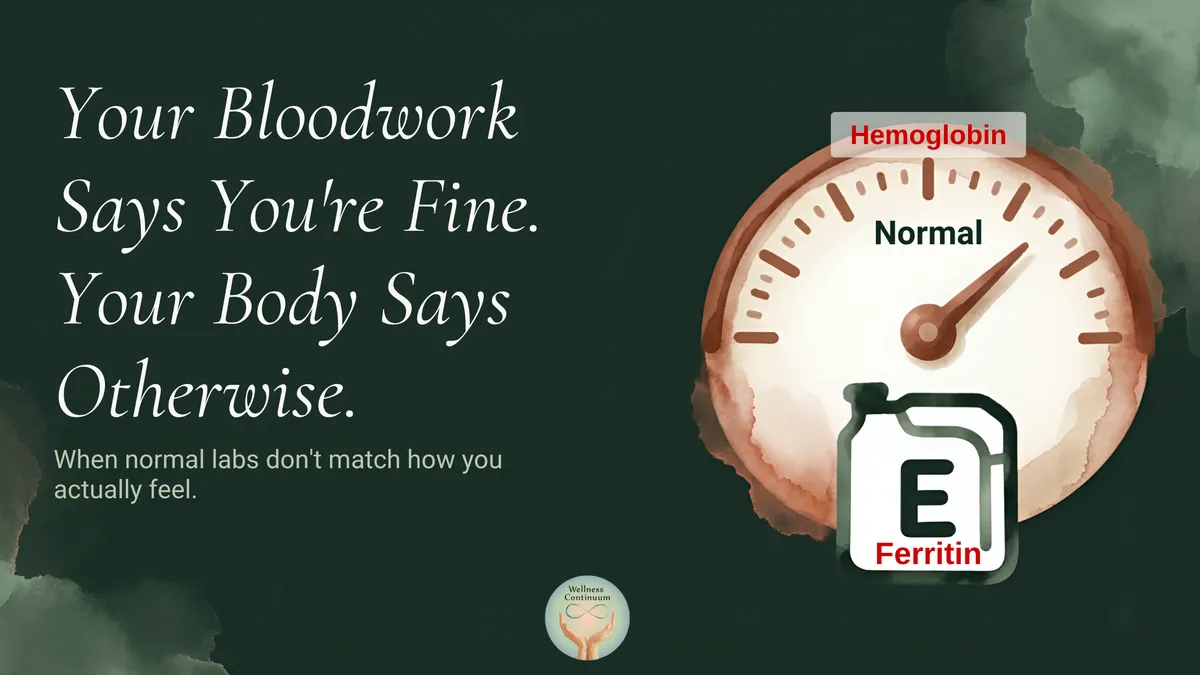
Your Bloodwork Says You're Fine. Your Body Says Otherwise. When normal labs don't match how you actually feel.
Your Bloodwork Says You're Fine. Your Body Says Otherwise.
You did the responsible thing. You went in, you got the standard panel, and it came back clean across the board. Your provider said the word "normal" in that tone that's supposed to be reassuring. And you walked out to your car and sat there for a second, because normal doesn't explain why you needed three cups of coffee just to answer email today.
Here's the thing nobody tells you at that appointment: "normal bloodwork" usually means about six things got checked. Not sixty. Six.
And here's the part that matters even if you've never had a single thyroid concern in your life: this isn't a thyroid post. This is a math problem, and it applies to basically every exhausted, foggy, over-caffeinated adult who's ever been told their labs look great.
What's Actually On a Standard Panel
A typical basic panel is checking: are your organs failing, are you critically anemic, is something acutely, dramatically wrong. That's an important job, and it's good at that job. It is a smoke detector. It is very good at telling you the house isn't currently on fire.
It was never built to tell you why you feel like you're running on the emergency generator instead of the actual grid.
Ferritin: The One Everyone Forgets to Ask For
Hemoglobin gets checked constantly. It's the "am I anemic" test, and if it comes back normal, most people stop there. Reasonable. Except hemoglobin is your gas gauge, and ferritin is your actual reserve tank in the trunk. You can be driving around on a gauge that reads "half full" while the reserve tank back there is bone dry.
Low ferritin with completely normal hemoglobin is one of the most common, most overlooked causes of real fatigue and hair thinning in women over 40, and it's not on a standard panel unless someone specifically orders it. Nobody checks the trunk unless they think to ask.
Most labs consider anywhere from about 12 to 150 ng/mL "normal." A ferritin of 15 is technically normal. It's also nowhere near the 70 to 100 ng/mL range where most women actually feel their best, with steady energy and hair that isn't shedding in the shower. Normal and optimal are, once again, two different report cards.
Vitamin D Isn't Just "Get More Sun"
Vitamin D deficiency gets waved off as a wellness-influencer talking point, which is a shame, because it's genuinely well-established, boring, mainstream biochemistry. Your cells need adequate vitamin D for a whole range of hormone receptors, including thyroid receptors, to actually respond properly to the hormones already circulating in your body.
Translate that: you can have "enough" of a hormone floating around and still get a lukewarm response from your cells if vitamin D is low, the same way you can have the wifi password memorized and still get no signal if the router itself is unplugged.
Most labs list the standard range as roughly 20 to 100 ng/mL. Functional medicine tends to aim higher, somewhere around 50 to 80 ng/mL, for the kind of energy and mood support vitamin D is actually capable of providing. A result of 22 is normal. It's also barely clearing the floor.
Cortisol: The Roommate Nobody Tested
Chronic stress keeps cortisol elevated, and elevated cortisol interferes with how efficiently your body converts and uses thyroid hormone, even if your thyroid itself is working fine. Testing your energy levels without ever glancing at cortisol is like investigating a noisy apartment and only interviewing one roommate.
Most standard panels don't touch cortisol at all unless there's a specific reason to suspect an adrenal problem. Which means for most women, it's simply never been asked about.
B12: The Classic Nobody Rules Out Anymore
B12 deficiency used to be the first thing anyone checked for unexplained fatigue. Somewhere along the way it fell out of fashion, mostly because it's not part of a standard metabolic panel or CBC, so it just quietly stopped getting ordered.
B12 is required for making red blood cells and for basic nerve function. Low B12 causes fatigue, brain fog, tingling in the hands and feet, and mood changes, and it can do all of that while your CBC looks completely unremarkable. It's especially common if you've ever taken a long course of certain acid-reducing medications, have any history of gut issues, or eat a mostly plant-based diet. None of that shows up on a standard panel either. Someone just has to think to ask.
Magnesium: The One That Lies Even When It's Tested
Magnesium is the one on this list that plays a slightly different trick, because sometimes it does get ordered, and it still doesn't tell you the truth.
Here's why: only a tiny fraction of the magnesium in your body actually lives in your blood. The rest is stored in your bones, muscles, and tissues. A standard blood magnesium test can come back completely normal while your actual tissue stores are running on empty, because your body will pull magnesium out of storage to keep blood levels looking fine for as long as it possibly can. It's less like checking the gas tank and more like checking whether the car is still rolling forward. Technically true, right up until it isn't.
Magnesium is involved in hundreds of basic processes in your body, including energy production, muscle function, and sleep. Low magnesium shows up as fatigue, muscle cramps, tension headaches, and poor sleep, and it's genuinely common, driven by chronic stress, caffeine, and a modern diet that doesn't include nearly as much of it as it used to. And because the standard test for it is famously unreliable, a lot of people get told they're fine on a test that was never built to catch the problem in the first place.
Why This Keeps Happening
None of this is because your provider is careless. A standard panel exists to catch what's dangerous, fast, and it's genuinely good at that. The gap isn't in the people. It's in the scope of what gets ordered by default, and what only gets ordered if someone thinks to dig further.
I dig further. Not instead of your regular care, alongside it. If you read the earlier posts in this series, this is going to sound familiar: it's the same "normal vs. optimal" gap we talked about with TSH, just applied to the rest of your bloodwork.
Here's what a fuller picture typically includes, on top of a standard panel:
- Ferritin, not just hemoglobin
- Vitamin D, checked directly, not assumed from sun exposure or a multivitamin label
- Cortisol, especially if stress has been a fixture of your life for longer than you'd like to admit
- B12, especially with any history of gut issues, acid-reducer use, or a mostly plant-based diet
- Magnesium, interpreted with a healthy dose of skepticism toward the number itself
- A fuller thyroid panel than TSH alone, because a normal TSH doesn't rule out the rest of the story
None of these are exotic. They're just not automatic, and "not automatic" is exactly why so many people spend years hearing "everything looks normal" while still feeling terrible.
What This Actually Looks Like
Composite example, not any one real patient: a woman comes in with a completely unremarkable basic panel and a genuine, persistent 3pm wall of exhaustion. Ferritin comes back low-normal. Vitamin D is deficient. Neither would have shown up unless someone specifically went looking. Addressing both doesn't "fix" her, it's not a cure for being a busy, tired human, but it's often the difference between white-knuckling through the afternoon and actually having something left at the end of the day.
If "my labs are normal but I still feel awful" is your current situation, you're not imagining it, and you're not lazy, and you're not just "getting older." You might just be looking at six data points when the real answer needed sixteen, and one of them might have lied to you anyway.
Six things got checked. Not sixty. I'd like to help you find the rest.
Start with a free 20-minute Wellness Gap Assessment at wellnesscontinuum.com
This blog post is for educational purposes only and does not constitute medical advice. Lab ranges and clinical information cited are for general educational purposes and may vary by individual and laboratory. Any patient scenarios referenced are composite and do not describe an identifiable individual. Consult a qualified healthcare provider for individualized guidance.
Views expressed are my own and do not represent the USPHS, HHS, or the Federal Government.
Stefanie Glenn, DNP, ANP-BC, ACNP-BC, FAANP, is a board-certified nurse practitioner and founder of Wellness Continuum, a virtual functional medicine practice in Maryland.
